October 14, 2026
Transcript below written and presented by Bart Mallon.
I have a confession to make. When I first sat down to write these opening remarks, I wanted to keep the term “Artificial Intelligence” completely out of this discussion.

We are all inundated with headlines. Models escaping their sandboxes, hacks, agent swarms. Frontier model founders warning us about human extinction. It’s overwhelming.
But the truth is, AI has become the unavoidable elephant in the room. It’s not just solving previously unsolvable math problems with relative ease, but it is actively redefining the future of investment management.
With that as a backdrop, I’d like to welcome you to the 2026 CoinAlts Fund Symposium.
We are here today for two reasons: to help you run your digital asset investment business better, and to explore the macro environment around our industry.
With respect to that macro environment, there has been an never-ending stream of headlines affecting our industry. Over the last 12 months alone:
- we’ve seen the continued expansion of prediction market investing (much of which uses some kind of crypto rails),
- real-world asset tokenization continues to be booming,
- and new strategies like crypto vault emerging.
Combine these advances with recent regulatory guidance from the SEC and CFTC, rising interest rates, a spiking national debt, and record highs in the traditional equity markets, and we have an incredible amount of ground to cover today.
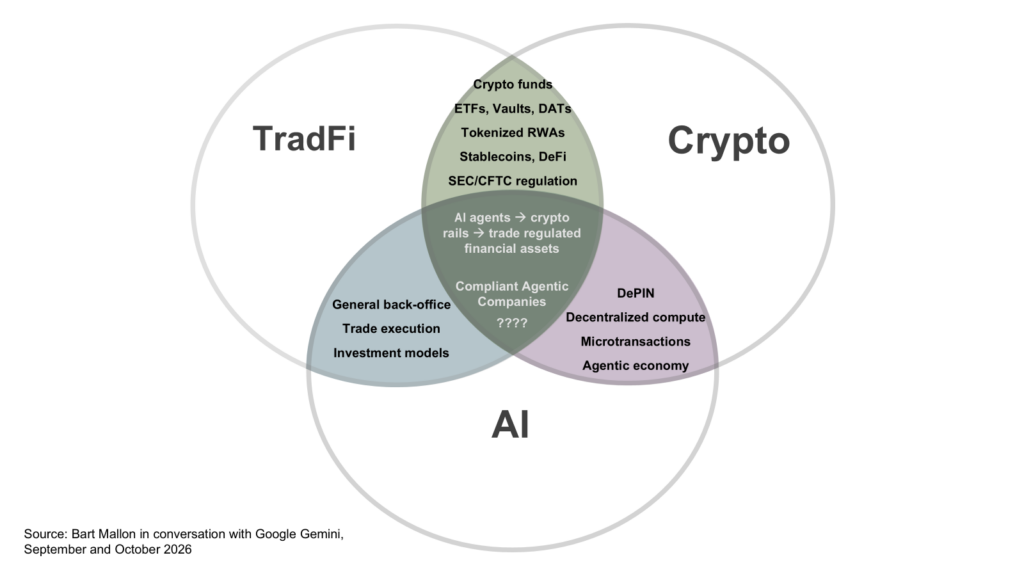
To try and make sense of all of the changes in the investment management industry from both the crypto trends and the emergence of powerful AI models, a couple of weeks ago I sat down to have a few conversations with my own AI model. Ultimately those conversations led to the development of Venn diagram that attempts to show us where we are right now, and where we may be going in the future.
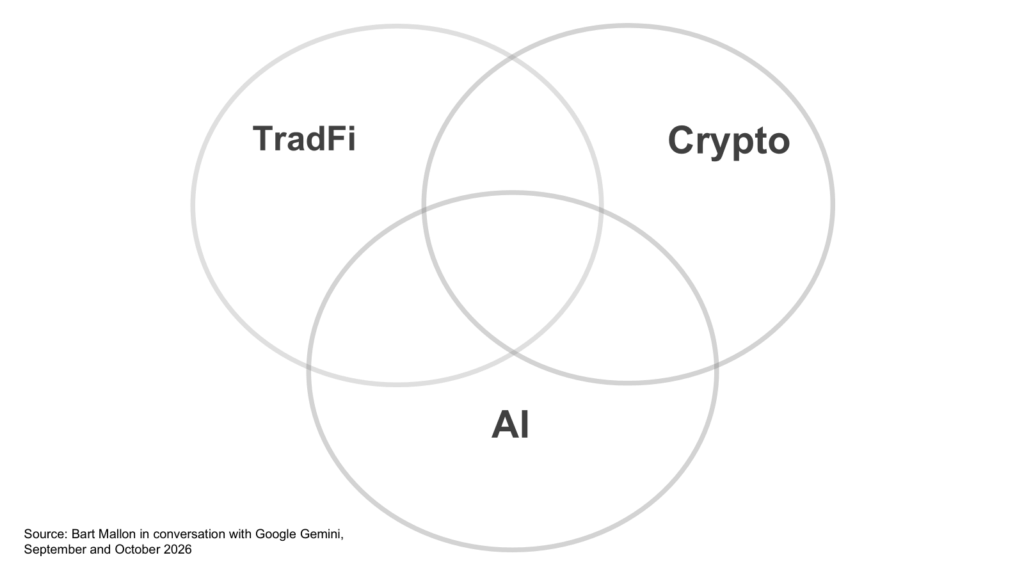
So here we start out with the three main sets—TradFi, crypto and AI and we’ll begin to talk about their overlap.
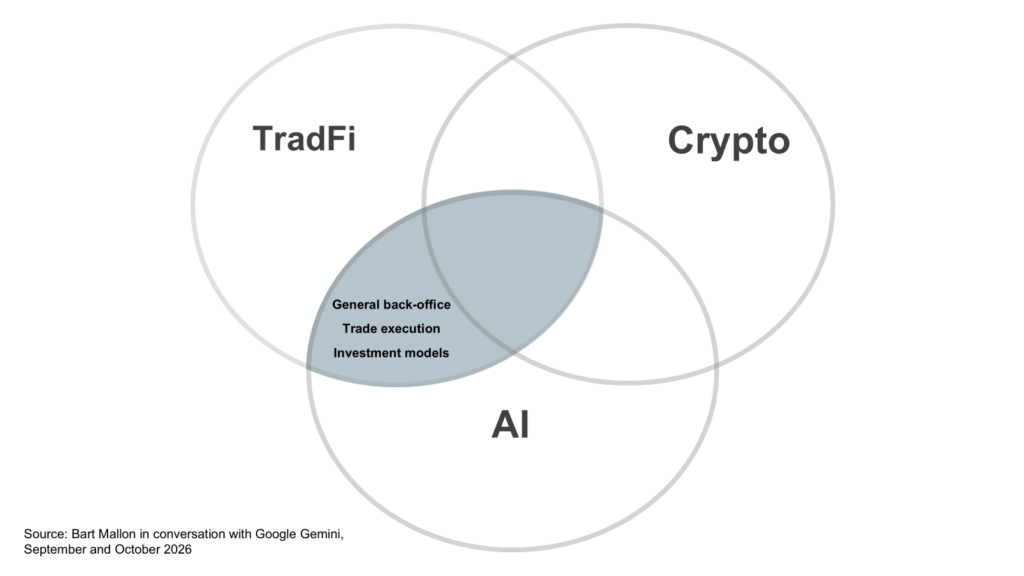
First, the intersection between TradFi and AI. There are no big surprises here yet—it’s mostly about marginal improvement and efficiency. We see traditional asset management firms leveraging AI for help with back office workflows and trade execution, similar to the optimization we saw with high frequency trading before. Managers are also using AI to develop or improve their investment models. It’s powerful, but it’s still fundamentally centralized and business as usual.
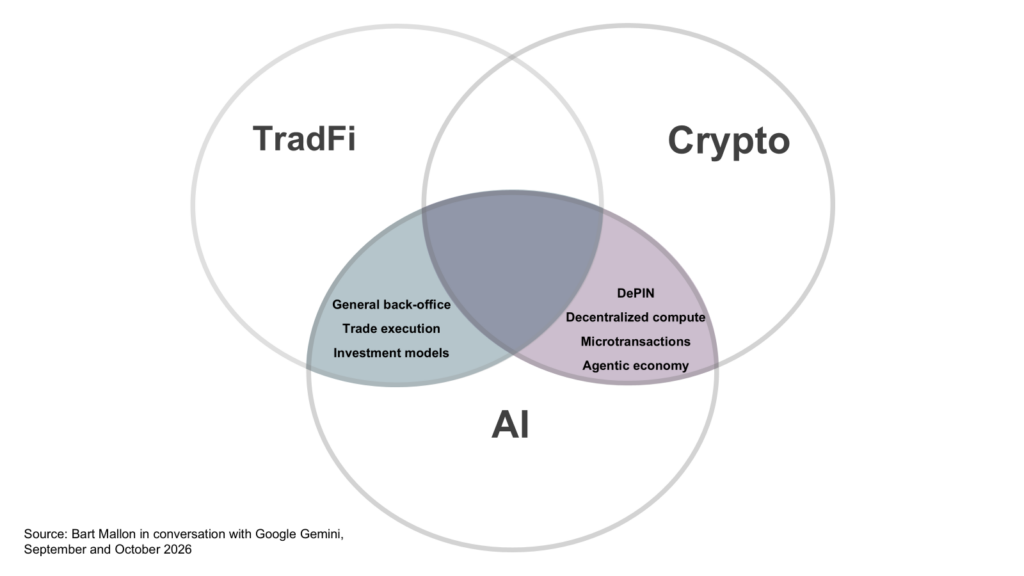
The second intersection is Crypto and AI.
Here the landscape changes entirely and moves toward being more technology focused. Already we are seeing the rise of Decentralized Compute and DePIN networks providing the physical infrastructure for AI. We also have microtransactions enabling machine-to-machine payments which we expect to increase dramatically in the future. Finally we have the birth of an agentic economy where we are learning to trust autonomous agents with actual crypto assets. What we are seeing in this intersection is the beginning of true agency and a push toward decentralized intelligence.
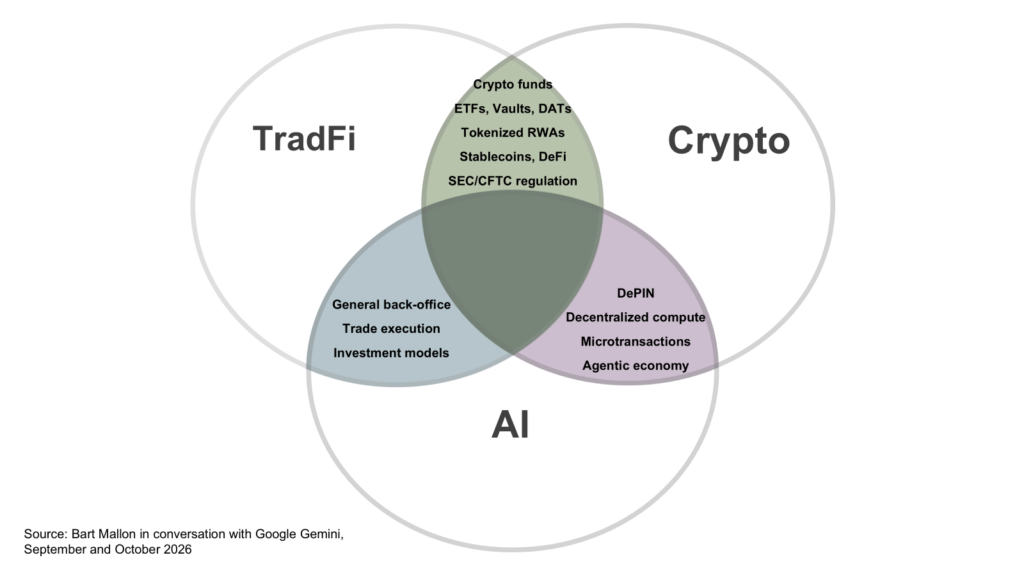
The next intersection is Crypto and TradFi. This is where many of today’s panel topics live.
We are seeing continued growth in crypto ETFs, institutional crypto funds, and automated vaults. Digital asset treasury companies are still a major part of the conversation too. These are no longer niche products; they are the primary vehicles institutional allocators are using to gain exposure.
But it goes deeper than just wrapping crypto in some kind of structure. Tokenized real world assets, including tokenized stocks, are increasing at breakneck pace—as I mentioned earlier, billions of dollars of RWAs are being tokenized on a MONTHLY basis.
Perpetual futures traded on chain are becoming a standardized investment product.
Stablecoins remain the killer app, with a circulating supply exceeding $300 billion.
DeFi use cases continue to expand, especially with the increase of on chain real world assets—in theory the ability to slice and dice assets to gain yield through DeFi is limitless.
Crucially, the shifting landscape of SEC and CFTC regulation, where regulators are beginning to work with the industry instead of against it, is helping our industry grow.
Finally, we have the center area where Traditional Finance, Crypto, and AI all intersect.
This is the area where we had more trouble trying to understand what is going on. Clearly at some point in the future we will have AI agents leveraging crypto rails to autonomously trade regulated financial assets. We expect these agentic structures to be deployed across the spectrum—from major wirehouses to individual investors.
Beyond autonomous trading, we expect to see the emergence of compliant agentic organizations—think of them as AI-managed DAOs where governance is hardcoded on-chain and day-to-day business execution is handled entirely by agents. In the near term, humans will remain involved by being system architects and potentially maintaining high-level governance but we can see that organizations will likely evolve to completely disintermediate humans.
In the future for these structures to scale, humans must be confident in what has been created—there will need to be strict programed guardrails, risk limits, and clear liability models. Ultimately, also, we must build frameworks that anchor agent actions to the physical world. This will require mechanisms for off-chain asset verification, potentially Proof of Humanity or personhood protocols like World Coin, and eventually, clear state and federal legislation regarding agentic operations and liability.
I’m sure that I am missing a bunch of items that should be on this Venn diagram, and I’m sure that over the next 12 months this diagram will look much different than it does today.
One more thing to mention, looking closely at these bottom three shaded areas, there is one glaring omission: regulation.
In this déjà vu moment, we see we are back to where crypto was ten-plus years ago—no cohesive regulatory framework and the industry begging for clear rules of the road.
As we’ve discussed ad nauseam over the years, Congress has completely failed to deliver a comprehensive crypto market framework and because of that vacuum, federal regulatory agencies have had to step in with the piecemeal, enforcement-led oversight we see today.
We are about to face the exact same battle with AI.
Once again our industry is going to have to write its own rulebook through customs and best practices.
Now, if you want a real-world case study of how fast these intersections are moving, look no further than real-world asset tokenization.
To tokenize an asset, one needs to create structures both domestically and offshore, create an intellectual property strategy, do tax planning, and analyze the business logic. It’s the exact work our firm has been immersed in for years.
So, we decided to practice what we preach.
I am incredibly proud to announce today that our law firm is officially launching our very own CFM Loyalty Token.
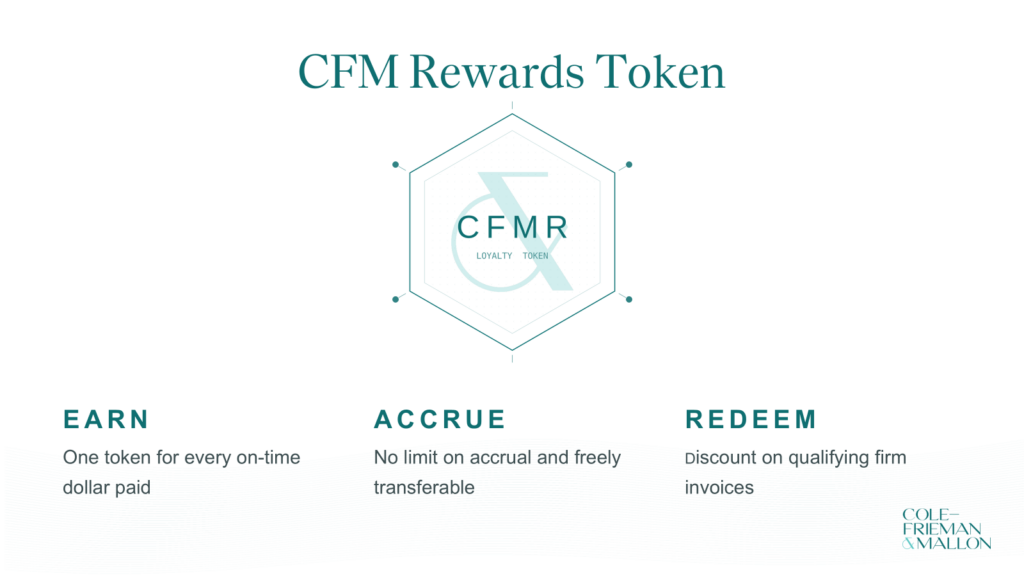
Clients will earn tokens for using our firm’s legal services and redeem them directly for discounts. This isn’t just putting airline miles on a blockchain. These are fundamentally client assets, owned by the client on-chain, and the client will be free to use these tokens with us or find other use cases for them.
What excites us most isn’t just using blockchain infrastructure, it’s the future breakthrough when we are able to iterate on what we build—when we layer AI onto this token ecosystem to drive automated, hyper-personalized value for our clients. Ultimately that’s what we’re trying to do: deliver more value to our clients. So we will see how this goes. It will be a living case study for everything we are discussing today.
As you go through today’s panels, I want you to walk away with two key items to think about: the practical reality of AI and your business, and the emotional question that AI raises.
First, the Practical Reality: many of the items we are actively deploying today in the TradFi/crypto bucket are rapidly moving toward that central AI intersection.
How will your business take advantage of this movement? What questions will we be talking about next year, and how can we help you during this transition?
Next, the Emotional Question:
This question is a bit different. We are looking at a future where AI is automated and running our financial systems, where AI has complete access to our business records, where agents are provided with a framework for the disposition of assets without human permission, and where business outcomes are generated entirely by machines.
It forces us to think about a fundamental question: should we be scared? How do we trust what the AI is telling us? We all have our certain excitements and trepidations about what this new future will hold. How do we emotionally handle how quickly our businesses, and our lives, are changing?
We certainly will not have any answers to any of these questions by the closing remarks tonight, but today is about exploring those boundaries. To help us explore, we have eight panels today covering the full spectrum of our industry’s critical issues, alongside two incredible fireside chats.
This conference is fundamentally driven by our four premier level sponsors who have all spent a significant amount of time working to make this happen: Cole-Frieman & Mallon LLP, MG Stover, Inc., Harneys, and KPMG. It is these premier sponsors who drive the planning and implementation of this conference.
Such a large event would also not be possible without our partner, supporter, and industry-level sponsors. We thank every one of these groups for their help putting on today and encourage you all to visit their booths outside.
This year, we owe a debt of gratitude to our advisory board of managers. We consulted them closely to ensure today’s content is directly relevant, timely, and actionable for your business.
Before we begin, a quick administrative note: to encourage an open, transparent and candid discussion, today’s sessions are entirely off the record and strictly for non-attribution. Please refrain from taking audio or video recordings. That said, our panelists are highly accessible looking forward to connecting, so we strongly encourage you to engage with them directly during the breaks and lunch.
So, let’s now begin the program. I would like to invite Lewis Chong of Harneys to the stage to introduce Sean Bill, in conversation with my partner Karl Cole-Frieman.
Thank you all for being here, and let’s enjoy the symposium!